
I’m building SOLONCODE, my own programming language
I’ve started building SOLONCODE, my own programming language for the products I want to create next. The current v0.4.5 is an early working prototype with typed programs, explicit permissions, a CLI and a browser runtime.
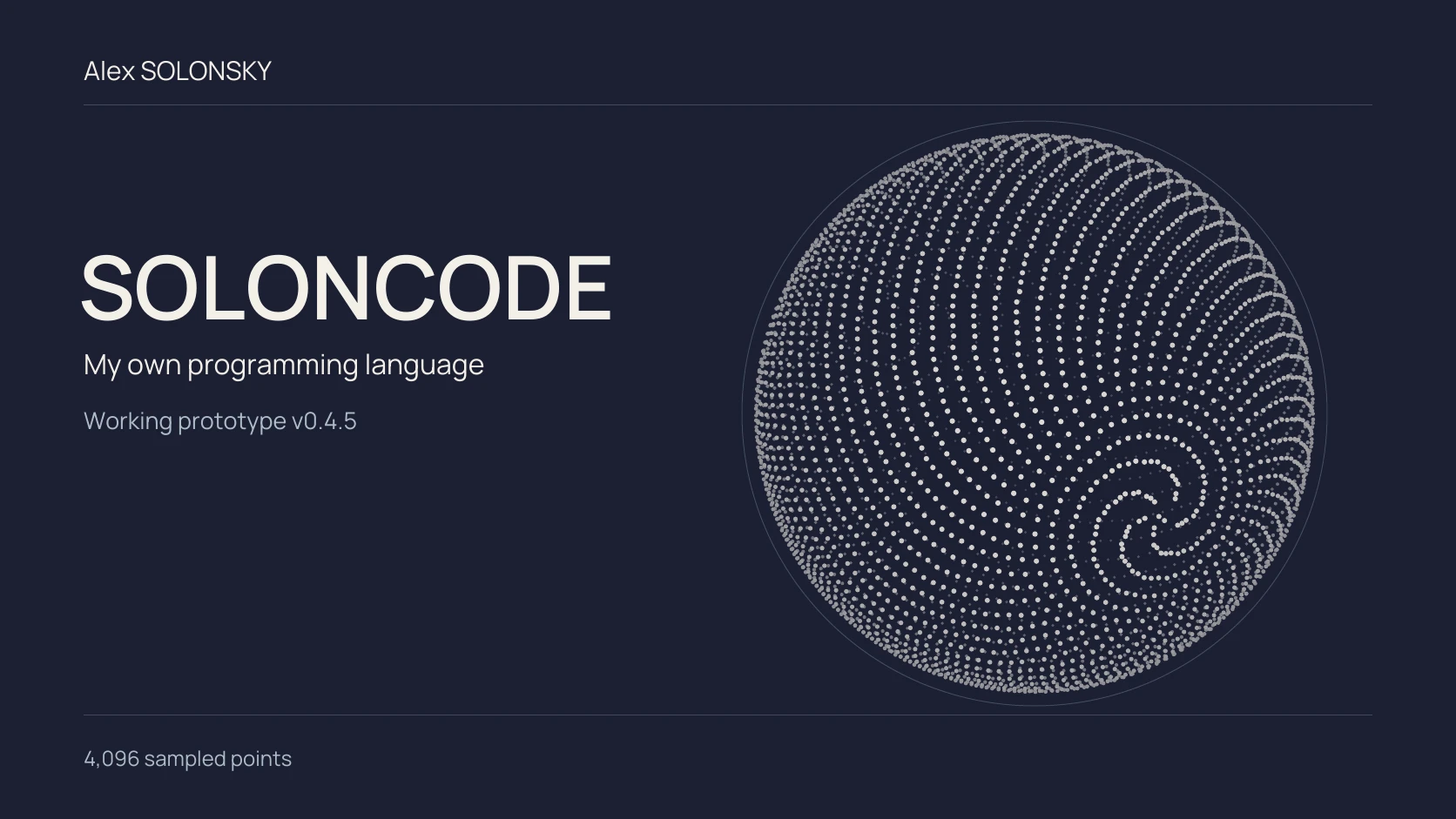
Why I’m creating it
I want to make data dependencies, permissions and checks explicit in the programs I use for my own products. SOLONCODE is where I’m turning those ideas into something I can run, inspect and improve.
One example that already runs
A Fibonacci sphere with a million possible points can be described by a 131-byte JSON rule. Storing all of its XYZ coordinates as Float64 values takes 24 MB. I keep the rule and calculate the point I ask for.
In the actual .solon run, the program returned point 42 and a block of eight points. I also checked 4,096 sampled points against a separate Python implementation. The largest coordinate difference was below 1e-12.
What those numbers mean
The 131 bytes cover the descriptor for this procedural sphere. Code, runtime and returned coordinates use additional memory. Equivalent lazy JavaScript uses the same 131-byte representation.
This example checks a representation and its output. It does not establish a general speed, memory or AI-cost advantage for SOLONCODE. I’ll judge those through matched tasks and the results I can verify.
The next builds
My next step is to develop the language through the products I’m building. I’ll share working examples, the decisions behind them and the checks that show what changed.
Questions
Can I use SOLONCODE today?
This announcement shows an early working prototype, v0.4.5. It is not a public release or a production-readiness claim.
Are all one million points stored in the image?
No. The illustration shows 4,096 sampled indices. The rule describes a population of one million possible points, calculated on demand.
Technical sources
- My published SOLONCODE announcementSix cards showing the sphere example, the actual point request and the limits of the comparison.